Rather than absorb the substantial natural beauty while I cycle between Morro Bay and San Luis Obispo each week-day, I elect to satisfy my own nature to quantify stuff. The most obvious and constant quantifiable variable is the vehicles that zoom by me. Also, though, there are certain road-side attractions: the seasonal rhythm of road-kill and the shame, thievery and forgetfulness embodied in certain jetsam (that is, things purposely thrown over-board) and flotsam (the accidental "cargo").
1st, the traffic:
I count "pinko" vehicles (hybrids) and "commie" vehicles (full electric). I do this for the same 17,44km section (an odd distance, but which I chose because, regardless of my ingress to or egress from HighWay 1, I will do that section every day). Note that, despite being cannon fodder for other cyclists these days (I've gotten progressively slower as I have lost weight, I guess due to reduced muscle mass and chronic under-fueling), I don't count other cyclists who pass me =). I chose these variables because they inform my world-view -- whether there is some hope that, despite the extravagent wealth of the U.S., people will factor in their respective social and ecological impacts in one of their most impactful consumer choices. As such, I have hoped to see a reduction in traffic, an increase in hybrid and especially full electric vehicles. The answers so far, after 434 samples in 637 days? Nope, not really.
I began tracking all of this 2024-02-02. In the first 100 samples, hybrids made up a median of 11,7% of total traffic and full electrics 3,7%. As of 2025-10-31 and 434 samples, the 100-sample rolling median is 12,5% and 3,7%, respectively. That marginal basis-point increase (a bit less than 7%) in hybrids is something, I guess, but hardly anything to pin one's hopes on. As for the density of traffic, that is dependent on the time (of day) that I'm on the road, which varies a fair amount, but has stayed steady within each time segment (each segment represents 1% of a day (14 minutes and 24 seconds)) at between 8,8 and 11,5 vehicles/minute, c an overall median of 9,5 vehicles/minute.
As it stands, even in this putatively progressive pocket of a generally progressive state, hybrids appear to be a slow-growth niche, and electric vehicles a stagnant niche within that niche. And the static traffic volume should not be surprising because it is effectively pre-determined, combining as it does the 3km guideline, beyond which the vast majority of people will not ride a bicycle, c our tendency in the U.S. to design infrastructure that encourages us to live far from where we work and shop. Still, somehow, disappointing. Non-sequitur as it might seem prima facie, perhaps it is better to pin one's hopes on g.l.p.-1 drugs -- they marry self-interest and social pressures (weight loss) c less food consumption (and therefore less environmental and social impact). I can't count g.l.p.-1 users on HighWay 1, though, so I'll continue to just count the be-damned vehicles noisily blitzing by instead of enjoying the native beauty in which I am ensconced =\
2nd, and speaking of animals and vehicles, the seasonality of road-kill:
January - February: owls, especially barn (this is the most prolific owl in the world, so perhaps this shouldn't be surprising)
March - May: snakes, mostly king-type, never (yet) rattle-type
May - August: skunks, and lots of them (skunks, as well as raccoons and opossums, are a road-kill constant, but my ride becomes noticeably more redolent of thiols (the compound that makes skunk spray (and certain parfums =) ) so powerful) in this time period)
September - November: deer, passerine birds and tarantulas
December: owls
I'm not sure why these up-ticks happen or, since I don't quantify any of it, whether it actually happens, but assuming my qualitative sensibilities approximate reality, I can guess:
-owls begin to hunt at dusk, which in winter co-incides c peak commuter times
-king snakes are born in small throngs in the spring, then disburse at more or less the same time (within 10 days of hatching)
-skunks begin venturing from the den in summer (at 40 - 55 days of age), un-tested and un-tutored in traffic dealings but fearless and then dead
-deer come down from the hills as back-country springs run dry, tree-cover lessens at higher elevations and one of their favorite foods -- acorns -- begin to drop at lower elevations
3rd, the embodied shame and secrets in certain road-side trash:
There is a constant deposit of 50ml - 300ml hard alcohol bottles on the shoulder, especially 99 Brand peach vodka (20U.S.D./liter, but less than 1U.S.D. for a 50ml bottle), FireBall Cinnamon whisky (20U.S.D./liter; also less than 1U.S.D. for a 50ml bottle) and, of all things, Sho Chiku Bai Premium ginjo (25U.S.D./liter). I imagine that functional alcoholics furtively imbibe these on the way to work, then toss them out the window to hide the evidence from family and police officers. Occasionally, a certain brand will disappear from the above mix, I imagine because the litterer has been arrested for d.u.i. or has resolved to quit drinking, but always the bottles begin to return to the shoulder within 50 days. There is also a steady supply of emptied mifepristone blister packs and, perhaps closely tied to this, the occasional pregnancy test.
The last item is yet more folly: Every 20 days or so, I find a wallet, credit cards, an id. and/or other such portfeuille effluvia. Occasionally it is obvious that this is due to the owner having left his/her wallet on the roof of his/her vehicle (because there is cash in the mix), but far more often it is a long trail of items that were tossed out the window as the pilferer went through the wallet. I do what I consider the right thing, which is to attempt to return the items back to the rightful owner or, failing that, turning the items over to the police. Typically the victim has already cancelled the cards, and so the only real value is to re-store some small faith in fellow humans and for him/her to get his/her id. and cash back.
2025-11-01
2019-08-24
G.M.C. Denali bicycle review & intrinsic sveltifying project -- from 13,51kg - 10,91kg...so far!

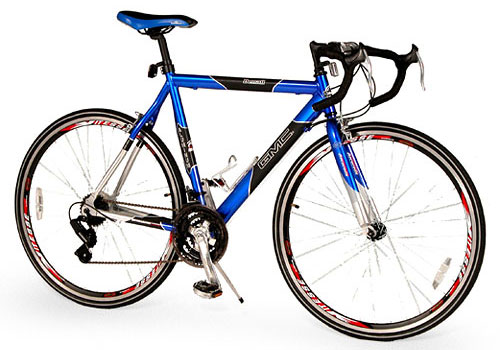 |
| The original more or less looked like a faded, oxidized version of this puppy, minus the saddle and saddlepost, which had been lost to history or a thief or Gremlins (note: not the American Motors Corporation kind) |
When the fine folks at the S.L.O. Bike Kitchen determined that a recently-donated sun-beaten, oxidized G.M.C. Denali was not worth the staff resources to revive, I decided to finally pursue an inchoate but years-long idea to make this low quality, ponderously leaden bicycle -- available at your local Big 5 for under 200U.S.D. and from your local hard-up klepto for 5U.S.D. or a sandwich -- as light as I could using only the components that came on the bike. Yup, that's a thing. And, as c any project by a person c too much time and disposable income, there are very particular rules surrounding this:
-for consumables that needed replacement (basically tubes and tires), these had to be equivalent in cost and quality to the O.E.M. spec.
-I gave myself some latitude on the touch points -- low-end clipless pedals and, though I'm being a self-sacrificing hero (think Jesus or orange-hued (except just around the eyes) narcissists who can't see beyond the front of their noses) by giving the god-awful o.e.m. saddle a go of it, I will replace it with a saddle of equivalent weight (220g) if my ass can't come to some accord with it.
What I did (and how much weight it saved, as well as occasional reference to particularly egregious amounts of time spent saving especially minimal amounts of weight):
-stripped frame paint (65g and untold -- but I'm going to tell it as 25 -- hours)
-halved size of saddle post clamp (33g (see photo below))
-removed padding from saddle, plastic bits and center ridge and set under some heavy boxes for 20 days to make my ass stop crying (145g (see photo below))
-removed bar tape (34g)
-removed kick-stand (189g)
-removed outer and inner chainrings and plastic bits (315g (see photo below))
-removed paint from rims (8g and untold (as in 12) hours)
-removed front derailleur, shifter, cable and housing (305g)
-shortened stem quill and bolt (34g)
-clipless pedals (Crank Brothers Candy) (112g)
-used 18 spokes on front wheel and had spokes shortened* (160g)
-used 27 spokes on rear wheel (18 drive-side 2-cross, 9 n.d.-s. radial) and had spokes shortened (70g)
-installed 0,9mm-thick (standard) 23mm by 622mm presta tubes (60g)
-installed 23mm by 622mm Michelin Dynamic tires front and rear (800g!)
-shortened the chain (35g)
-replaced rim strip with packing tape (30g)
-drilled out back of freewheel (2g and burned through a drill-bit!)
-drilled out brake levers (2g)
-sawed off the top 30mm of the saddle tube (19g)
-hacked off hub axle ends (20g)
-hacked off saddle post clamp ends (3g)
-reduced size of handlebar shims (50g)
-removed various reflectors and washers (75g)
-removed 35mm from saddlepost (15g)
-sawed out most of the kick-stand mount (it serves some function to brace the chainstay/b.b. junction, so I kept some of it in there) (17g)
*the spokes began to snap at 1 650km, as one bike shop, which sagaciously refused to cut the spokes for me for this very reason, foretold. I've plenty of back-ups, but when those run out, I will replace the 18 spokes c 2,0mm unswaged stainless steel spokes
-sawed off the top 30mm of the saddle tube (19g)
-hacked off hub axle ends (20g)
-hacked off saddle post clamp ends (3g)
-reduced size of handlebar shims (50g)
-removed various reflectors and washers (75g)
-removed 35mm from saddlepost (15g)
-sawed out most of the kick-stand mount (it serves some function to brace the chainstay/b.b. junction, so I kept some of it in there) (17g)
*the spokes began to snap at 1 650km, as one bike shop, which sagaciously refused to cut the spokes for me for this very reason, foretold. I've plenty of back-ups, but when those run out, I will replace the 18 spokes c 2,0mm unswaged stainless steel spokes
As yet, the bicycle has gone from 13,51kg to 10,91kg (2,60kg, or 19,2%). After the usual teething problems -- which mostly meant the olive oil convincing the chain links that they could flex again after years kinked into downward-dog and half-a-dead-bug -- the bike works well. This includes the indexed shifting, which flows smoothly even under load, and the Lee Chi brakes, which have a terrible reputation but which work very well on this bike, perhaps in part because they are stopping 11kg of bicycle + me (64kg) instead of 13,5kg of bicycle + typical U.S. male (89kg)?! <11kg 12t="" 13="" 30km="" 3="" 5="" 6="" 75="" 79="" a="" allow="" almost="" and="" anything="" at="" be="" bike="" bogs="" climbs="" current="" despite="" does="" down="" even="" for="" freewheel="" gear="" gearing="" give="" gradient.="" h="" has="" heft="" highest="" hit="" i="" impossible="" instantly="" instead="" is="" it="" kg=")" little="" long="" look="" low="" m="" may="" me="" meters="" min.="" momentum="" more="" my="" nbsp="" nonetheless="" not="" notice="" of="" on="" only="" over="" p="" particularly="" proven="" rather="" reasonable="" regular="" rev.="" rides.="" slower="" so="" steed="" t="" take="" than="" the="" to="" twice="" unfavorable="" very="" weight="" well="" when="" which="" with="" would="">
Other modifications to come:
-extensively drill out rear derailleur
Possible modifications to come:
-there is a flat-bar version of the Denali, which I prefer; given that the current handlebar weighs over 750g (!), even a steel shot-gun bar would save a good 500g, cheap cross-top levers would save a further 60g and shorter housings and cables'd save around 20g
-though I think it breaks too far from the spirit of the build, it would be tempting to put a SunRace friction thumb shifter on the flat bar, which would save 60g and be more functional than the current grip shifter, which, because it is index-only, limits the bike to 7-speed freewheels
-strip fork paint and cut out rack mounts; this would not save any significant weight since the fork'd need to be re-painted (since it's steel), though perhaps a thin clear-coat would be lighter than the current paint
crap wears out, and cheap crap wears out fast:
-the Michelin Dynamic is an inexpensive and light wire-bead tire; by the "cheap, light, durable: pick two" axiom, durability has to be the loser c the Dynamic, and so it was. The rear started showing threads at 1 900km and was toast by 2 300km; I managed to get to nearly 2 700km before the casing started to deform. To cut down on environmental impact, I replaced it with a used tire from the Bike Kitchen, in this case a 230g (not even close the advertised weight of 165g!) Bontrager Race X-Lite, which was expensive (when new) and, despite the false advertising, fairly light (50g lighter than the Dynamic).
-the 13t on the freewheel started skipping under pressure after only 1 800km. It steadily worsened, of course, making it nearly unusable by 2 500km. Then the 15t started skipping. Cheap steel, I guess. I searched for a reasonably priced used 12t - 28t 7-speed freewheel on eBay that had replaceable cogs, but had no luck. Eventually and a bit desperately, I took the freewheel that was mounted on my Volunteer of the Year award -- a Sachs Maillard LY94 that happened to be a 13t - 28t 7-speed -- and put it on the Denali. This freewheel has the huge advantage of having replaceable cogs, though the cogs are getting very hard to find.
-the rear hub races are also, apparently, made out of very cheap stuff because, right around 5 000km, the drive-side race essentially evaporated (see photo). After this bit of catastrophe, which involved a steamed (as in my mood) 3km walk home, I determined to get a better-quality (though still cheap) hub to replace it. Guilt got the better of me (because a better quality hub would also be around 150g lighter, which felt like cheating) when I was sifting through the used hubs at the Bike Kitchen, though, so I looked around for something of equivalent crap-level, which I found in their whole-wheel section. I asked if I could extract the hub from the wheel which, because the staff is familiar c my project, got a "whatever floats your boat" response. So now I have a HungSen steel 3-piece loose-ball-cup-and-cone rear piece-of-crap hub that is nearly identical to the old one in weight and the aforementioned-crap-level. After re-wiring my brain to be able to re-piece-together the rather complex lacing pattern, the only thing that required adjustment was the "high" limit screw. Which I couldn't do because that'd somehow unthreaded itself and abandoned ship in the last few hundred km of riding. My brother let me cannibalize one of his derailleurs, though, so, once that was
crap wears out, and cheap crap wears out fast:
-the Michelin Dynamic is an inexpensive and light wire-bead tire; by the "cheap, light, durable: pick two" axiom, durability has to be the loser c the Dynamic, and so it was. The rear started showing threads at 1 900km and was toast by 2 300km; I managed to get to nearly 2 700km before the casing started to deform. To cut down on environmental impact, I replaced it with a used tire from the Bike Kitchen, in this case a 230g (not even close the advertised weight of 165g!) Bontrager Race X-Lite, which was expensive (when new) and, despite the false advertising, fairly light (50g lighter than the Dynamic).
-the 13t on the freewheel started skipping under pressure after only 1 800km. It steadily worsened, of course, making it nearly unusable by 2 500km. Then the 15t started skipping. Cheap steel, I guess. I searched for a reasonably priced used 12t - 28t 7-speed freewheel on eBay that had replaceable cogs, but had no luck. Eventually and a bit desperately, I took the freewheel that was mounted on my Volunteer of the Year award -- a Sachs Maillard LY94 that happened to be a 13t - 28t 7-speed -- and put it on the Denali. This freewheel has the huge advantage of having replaceable cogs, though the cogs are getting very hard to find.

Yup, it's about as uncomfortable as it looks, but relieving the Atlas Mountain running down the spine of it sure helped, and it saved 10g more! =)
 |
| With some significant hacksaw time, the clamp itself went from 55g to 22g, the saddlepost lost 15g (35mm-worth of 'post) and, after lopping off the top 30mm of the saddle tube, the bike lost another 19g |
 |
| Hacking off the axle ends from both hubs saved another 20g and, not that I give a crap, but must make the system more aerodynamic, too! |
 |
| The prominent teeth on the 38t are not narrow-wide, of course, but they hold the chain well in all gears; I tried life sans bottom bracket bolts to save 35g, but the crank will not hold! |

2014-05-31
Europe, scene 3, take 4
When a guy 20 years your senior passes you on his 1992 p.o.s. "mountain" bike, then takes a few minutes to pet a donkey, drink a beer and smoke a cigarette, then passes you again, this means that he is very talented, very Italian (that's the smoking the cigarette part) and that I was having a bad day. That's true even if some of the above isn't entirely or even partially true, though he did stop at a bunch of beer tents, which happened to be across from a field of donkeys, and a lot of people were petting those donkeys, and I did see an older cyclist smoking a cigarette at the acme of the climb. I can at least confirm that his bike was a low-quality make from the 1990s early. And he did stop and then pass me again.
This was the climb -- ascent -- to Cima Grappa, yet another Giro finish at a battle site or, in this case, two battles site, of the 1914-1918 War. The second battle was a biggie, and not just because masses of Italian soldiers didn't give up without a fight. That 2nd battle closed the southern front of the war for final (I'd say "for good," but not much good came from that war, except soy sausages, best cooked with one of those new-fangled flame throwers). And that put the Italians in a position to gain all sorts of territories on its wish list, including the much mentioned Sud Tirol and the crown jewel of those acquisitions, which just happens to be the finish town of the final Giro stage, Trieste.
There was one good thing about the day, besides the exciting action on the course: it didn't snow and it only rained a little. Though I'd discovered in the previous stage a great cure for the near-freezing temperatures. The big balloons you see at the finish lines of races are powered by a constant supply of pressurized air, which, because these are off-the-grid mountain tops, require the services of portable generators. And those generators put out heat. Lots of it. Fumes, too, but mostly carbon monoxide; if I can't sense it, it doesn't exist! So I set myself right behind one of those generators and learned a new word from passerby who thought the dorky guy without pants or socks was pretty darned clever: scaldare. I heard it a lot, at first thinking they were smiling and telling me I was going to scald myself you stupid guy in shorts and no socks, but then, with the help of my little dictionary, I realized that they were smiling and saying "that is warm, you stupid person on a mountain top in shorts and no socks." As it turns out, I did scald (English usage) myself a little, but it was so worth it that I'd do it even if I were wearing polyester melt-to-my-skin-after-scalding socks.
And so that was my day on the mountain. Three days, actually, but this isn't about veracity, as should by now be clear, but about convenience and the ravages of time (on my memory).
Now I am off to France for another race. A land of soy-milk and great bread. The fruit and jam in Italy've been great, but the bread! -- see the recipes for the two types of Italian bread, posted below:
Italian Italian bread recipe (makes 300g or 1,5 liter loaf; specific gravity 0,2):
300g of marshmallow, hopefully vegan
Bake until thickly crusted
Let sit 3 days in open air or until stale enough to leave sensation of baking soda in mouth
Important: while selling, smile as if this is normal
Italian Tirolian (Austrian, if a Tirolian is in the room) bread recipe (makes 1,5kg or 300ml loaf; specific gravity 5,0):
500g wheat husk
500g rye husk
500g softened nut shells and fruit stones
1g (1ml) water
Bake until nutty smell brings in customers
Warning: serve warm; these loaves can cause internal bleeding if served stale
Important: while selling, frown and seethe that Tirol is not part of the Eastern Kingdom (that is, Österreich (that is, Austria)).
This was the climb -- ascent -- to Cima Grappa, yet another Giro finish at a battle site or, in this case, two battles site, of the 1914-1918 War. The second battle was a biggie, and not just because masses of Italian soldiers didn't give up without a fight. That 2nd battle closed the southern front of the war for final (I'd say "for good," but not much good came from that war, except soy sausages, best cooked with one of those new-fangled flame throwers). And that put the Italians in a position to gain all sorts of territories on its wish list, including the much mentioned Sud Tirol and the crown jewel of those acquisitions, which just happens to be the finish town of the final Giro stage, Trieste.
There was one good thing about the day, besides the exciting action on the course: it didn't snow and it only rained a little. Though I'd discovered in the previous stage a great cure for the near-freezing temperatures. The big balloons you see at the finish lines of races are powered by a constant supply of pressurized air, which, because these are off-the-grid mountain tops, require the services of portable generators. And those generators put out heat. Lots of it. Fumes, too, but mostly carbon monoxide; if I can't sense it, it doesn't exist! So I set myself right behind one of those generators and learned a new word from passerby who thought the dorky guy without pants or socks was pretty darned clever: scaldare. I heard it a lot, at first thinking they were smiling and telling me I was going to scald myself you stupid guy in shorts and no socks, but then, with the help of my little dictionary, I realized that they were smiling and saying "that is warm, you stupid person on a mountain top in shorts and no socks." As it turns out, I did scald (English usage) myself a little, but it was so worth it that I'd do it even if I were wearing polyester melt-to-my-skin-after-scalding socks.
And so that was my day on the mountain. Three days, actually, but this isn't about veracity, as should by now be clear, but about convenience and the ravages of time (on my memory).
Now I am off to France for another race. A land of soy-milk and great bread. The fruit and jam in Italy've been great, but the bread! -- see the recipes for the two types of Italian bread, posted below:
Italian Italian bread recipe (makes 300g or 1,5 liter loaf; specific gravity 0,2):
300g of marshmallow, hopefully vegan
Bake until thickly crusted
Let sit 3 days in open air or until stale enough to leave sensation of baking soda in mouth
Important: while selling, smile as if this is normal
Italian Tirolian (Austrian, if a Tirolian is in the room) bread recipe (makes 1,5kg or 300ml loaf; specific gravity 5,0):
500g wheat husk
500g rye husk
500g softened nut shells and fruit stones
1g (1ml) water
Bake until nutty smell brings in customers
Warning: serve warm; these loaves can cause internal bleeding if served stale
Important: while selling, frown and seethe that Tirol is not part of the Eastern Kingdom (that is, Österreich (that is, Austria)).
2014-05-26
Europe, take 3, scene 3
Here's my gulden fiets, as a Dutch guy once called it ("gold bike," he told me), atop the Gavia. My steed was still smarting from a broken chain on the way up (easy fix) and some derisive comments an Australian Pantani doppelgänger had slung at it at the summit. Damn those beer-swilling skin-cancer children-of-pri
Europe, take 3, scene 2
Wild camping is what you do when the campground to which you just busted your tukes for 120km to get to is closed, it's dark, and you have an in-born tendency to say "[expletive deleted, but the word isn't flip or fudge (it's fuck)] it." At least this round of "selvaggio" camping was in a campground. Not to suggest that there was hot water, tepid water or any water at all. Or facilities, as the Victorians'd say if they'd thought of it. I'd been looking forward to a hot shower to wipe off the disgusting and because the town to which I'd arrived, Sondalo, is at 870m, and there was a chill in the pure mountain air. But I bundled up, cinched down the sleeping bag and had one of the toastiest, most humid nights of sleep in my life. And I've been to humid hell -- Indiana and (you read that right: and) Maui. But it was a great night of sleep. Until the weed-whacker guys came in their little 3-wheeled truck at 07:30 to start prepping the campground for opening. They left me alone, as these northern Italians seem to do with everything, and I made my lazy-ass way over to a little town called Edolo. Most of the passes in this part of the Alps are still closed, but one of the most challenging climbs in the world, the Mortirolo ("Mountain of the Martyr," as named in 774 in reference to a battle between the evil Lombards and the evil Franks; also, Lance (yup, that Lance) called it the toughest climb he'd ever done; he said that while hopped up on EPO and HGH and such; imagine what I, hopped up on bread, jam, an orange and "Brasil" juice (what the Italians call a tropical fruit juice medley; I don't know if the word also describes a certain style of depillitation) faced). And, as I mentioned above, it was closed. But I figured "what the fuck," I could hoof it in my tractionless, open-holed shoes if I had to. What's not to like about my plan? I even had food. Scraps of CostCo tortilla chips can be filling. Or so I found out at the summit when I consumed said chips without chewing. I found an open campground in that little town (the aforementioned Edolo). I was, literally, the only camper there. A hot hot long long shower, a thorough clothes wash and a night of reading Treasure Island (it came free with my e-reader program and, anyway, my oddly similar book on the medieval history of Europe'd expired). Today I rode up the Passo Gavia (site of more war, though of a less bloody result and which ended when the Swiss got pissed at the Austrians because Austrian missiles had to go over Swiss territory to get to their Italian supply-convoy targets), which was harder than I can possibly describe. And it was also closed. But I and plenty of other cyclists worked around that. Which, for me anyway, included scrambling up a slope to get around a work-crew, the agenda of whom did not include making way for a cyclist who shouldn't've been there anyway you cut it. Now I'm at a "campeggio" that has free wi-fi and hot water. The water costs a euro, though, so I did the poor-man's shower and called it buono. Tomorrow the Stelvio -- another closed pass --and one day closer to screaming out all of my frustrations, of which crappy Italian bread is tops on my list, at professional cyclists. Cheeow, as people keep saying to me here. When I sing the cat food commercial in reply, I get nothing....
Europe, take 3, scene 1
After a thrilling late-night sprint from Como to Lenno, for the first time since arriving I am able to not smell. This isn't to say that I can't smell things but rather that i cannot be smelled. And this is to say that I am lounging about in a small campground that is scrunched between a tall mountain and a large lake (the German name of which is see, as in sea. Actually, my dictionary says that's German for lake, but I'm not convinced) and which has showers. Free with cold water, 1 euro for hot. I paid the euro.
I spent the flight caught between the window and Jaime, a large, friendly man whose arms and legs and head tended to splay out from his core like a distressed crab. No doubt out of concern for the safety of the stewards, Jaime biased the direction of his splaying toward me, particularly his feet. When Jaime had to get to the bathroom, his search for his shoes led not to beneath his seat but to mine. Though my constitution suggested otherwise, I stayed put for the duration of the flight. The thought of discomfiting Jaime, and therefore our whole side of the plane, was enough to keep me planted. I was well-entertained nonetheless -- four movies, a short documentary and a Lady GaGa video. Once de-planed, I rode until darkness -- a little past, but don't tell Ma -- and found a comfy spot in the woods. 14 hours and 7 mosquito bites later, I got up and haltingly made my way to Como. Haltingly because I am taking countruh roads, the signage for which is both spotty and randomly placed. My Italian has grown leaps and bounds since I discovered that combining French, Spanish and a stereotypical Brooklyn-Italian accent was completely ineffective, but I've yet to learn to say "Why the fuck is the street sign for Via Giovanno the goddamned Twenty-Third [of which there are many] covered In ivy on the 3rd story of the building on the other side of the street?" Working on it.
I will rest here for a day, enjoying my baby-smooth skin, then head to the mountains. I think. I'm sort of fancy-free until the Giro hits the Dolomites 2014-05-27, so I may change my mind. It's a difficult old life.
Wi-fi has been spotty, as has been my battery performance, so I'll post when I can. I hope the heat isn't too horrifying. It's a gorgeous 21* with a mix of puffy clouds, belvederes of the Dolomites along a corniche and happy sun where I am. Just to rub it in.
I spent the flight caught between the window and Jaime, a large, friendly man whose arms and legs and head tended to splay out from his core like a distressed crab. No doubt out of concern for the safety of the stewards, Jaime biased the direction of his splaying toward me, particularly his feet. When Jaime had to get to the bathroom, his search for his shoes led not to beneath his seat but to mine. Though my constitution suggested otherwise, I stayed put for the duration of the flight. The thought of discomfiting Jaime, and therefore our whole side of the plane, was enough to keep me planted. I was well-entertained nonetheless -- four movies, a short documentary and a Lady GaGa video. Once de-planed, I rode until darkness -- a little past, but don't tell Ma -- and found a comfy spot in the woods. 14 hours and 7 mosquito bites later, I got up and haltingly made my way to Como. Haltingly because I am taking countruh roads, the signage for which is both spotty and randomly placed. My Italian has grown leaps and bounds since I discovered that combining French, Spanish and a stereotypical Brooklyn-Italian accent was completely ineffective, but I've yet to learn to say "Why the fuck is the street sign for Via Giovanno the goddamned Twenty-Third [of which there are many] covered In ivy on the 3rd story of the building on the other side of the street?" Working on it.
I will rest here for a day, enjoying my baby-smooth skin, then head to the mountains. I think. I'm sort of fancy-free until the Giro hits the Dolomites 2014-05-27, so I may change my mind. It's a difficult old life.
Wi-fi has been spotty, as has been my battery performance, so I'll post when I can. I hope the heat isn't too horrifying. It's a gorgeous 21* with a mix of puffy clouds, belvederes of the Dolomites along a corniche and happy sun where I am. Just to rub it in.
2012-10-10
reductionism as applied to climbing Mount Hamilton
The climb to Lick Observatory is more appropriately described as three separate climbs in quick succession, interrupted by brief downhill interludes. The total trip, from the corner of Alum Rock Road and Mount Hamilton Road to the parking lot of Lick Observatory, is 29,6km, 26,2km of which is climbing. Total vertical is 1 280m (1 440m including the return trip).
Climb one (Category 2) is 9,7km long and goes from an elevation of 140m to 590m (450m vertical). This sector is fairly steady for the first 6,0km (310m vertical, 5,2%), then levels off to a false-flat for 1,6km (25m vertical, 1,6%), then tips up again for the final 2,1km (115m vertical, 5,5%). I suspect this climb qualifies as Category 2 only by virtue of its length; there are short sections of the third sector that are in the 7% - 8% range, but generally the grade is something one would find on a Category 3 climb. Most of the first 7,5km of this climb is fully exposed. This makes for great views, particularly on the rare day when the haze and smog are at a dull roar in the Valley, but if the temperature is over 297°K (24°C), the heat becomes a factor. The final 2,1km is mostly shaded, which is nice, but the Lord giveth, the Lord taketh away: 8,5km into climb one, the asphalt turns into unpleasantly rough chip seal, and stays that way for the next 9,7km. A pro can clean this climb in 21:00 - 23:00; most folks amble up in 37:00 - 40:00.
Climb one is followed by a 2,0km descent that goes from an elevation of 590m to 500m (-4,8%). It is twisty for the first several hundred meters, but soon straightens out. The road is rough and has several difficult-to-see potholes. If one is aggressive, this section can be done in 3:00 - 3:30, but that is for brainless types -- young males between 15 & 25. Those outside this sociopathic demographic take 4:30 - 5:30 to get down.
Climb two (Category 3) is 5,4km long and goes from an elevation of 500m to 710m (210m vertical, 3,8%). The paper profile of this climb is deceiving. Perhaps because the bottom section is its steepest sector and one has been softened up by climb one, this is the part of the trip I find most difficult. This is exacerbated by the exposure -- 4,5km of this climb is in full sun. The shade, which is of the dappled variety provided by beautiful oak trees, is in fits and patches near the top. Another welcoming feature of the acme of this climb is the end of the execrable chip seal. From there on the asphalt is sexy smooth. A pro can do this climb in 11:00 - 13:00; most folks take 20:00 - 25:00. On the return trip, climb two is best descended with a wary eye; nearly all of the sharp corners between the 2nd and 5th kilometers are littered with significant rockfall. If fresh, this can include rocks as large as 1 liter; if the rockfall has been on the road for awhile, the crushed rock is slippery.
Climb two is followed by a 1,4km descent that goes from an elevation of 710m to 680m (-5,2%). The first corner of this downhill is particularly sharp, often with rock-litter on the pavement, but the rest is easily navigated. The above-mentioned brainless young males can do this in less than 2:00, despite a burp of a rise near the bottom. Most folks do this in 3:00 - 3:30.
Climb three (Category 1) is the doozy. It is 10,1km long and goes from an elevation of 680m to 1 280m (600m vertical, 5,9%). Much of the climb is shaded, again by the oaks, but, as one gets higher, also by pine trees. One can see the end goal -- the Observatory -- for much of the last 5km. The Observatory isn't coy; it quickly, mercifully grows larger. It has several switchbacks along the way, but there are several 100m - 200m-long "ramps" that are at a 7% - 8% gradiant. The pros can do this section about as fast as a human can run 10km on a track -- 26:00 - 27:00. Most folks take 45:00 - 55:00.
So a world-class male climber can climb Mount Hamilton in 1h00 - 1h05 (the Strava record is around 1h05, but this doesn't include the times of the mountain goats riding over it for the Tour of California), a top female in 1h15 - 1h20. Top regional riders can do it in 1h05 - 1h10. A point of pride for Joe Climber is the 1h30 barrier. Breaking 1h40 is nothing to brag about, but it would put one in good standing with most roadie snoots. Most folks who are in good shape and who have a functioning bike take 1h45 - 1h55.
The greatest reward for the long climb to the peak of Mount Hamilton is a tough call. It's certainly not the view, which is nearly always marred by Valley smog and haze. Rather, it's a toss-up between the Obersvatory's fountains, which have incredibly refreshing artesian water -- refrigerator cold and so satisfying after drinking tepid, BPA-laced water all the way up the climb -- and the near-hidden courtyard just behind the Observatory. If one comes armed with a book, some extra food, and perhaps a mat to lay on, three hours can pass by in relaxing, shade-dappled style. The Observatory itself is another gem. There are tours offered every 30-minutes in the afternoons and the self-guided tour is excellent. And one can thank the Observatory for the relatively steady and reasonable grades -- how else could horses get a monstrous telescope to the top of a mountain?
The typical temperature gradient of 6,5°K/1 000m elevation generally does not hold true for Mount Hamilton. Often there is no gradient at all in the summer -- if it's 300°K in the Valley, there's a good chance it will be the same at the Observatory. The ambient temperature in the aforementioned sections exposed to the sun is exacerbated by the heat reflecting off of California's depressingly yellow grass and the ubiquitous rock-cuts. From mid-autumn to mid-spring, though, the ambient temperature is nearly always below 295°K and there is a temperature gradient, though still less than 6,5°K/1 000m. At this time of year, even if one is packing light, it is a good idea to bring a top in the 150g/square meter - 200g/square meter range, depending on one's proclivity to shivering.
2012-09-19
C.C.S. team-time medians, 1987 - present
C.C.S. |
d. 1 b. | d. 2 b. | d. 3 b. | d. 4 b. | d. 5 b. | overall | d. 1 g. | d. 2 g. | d. 3 g. | d. 4 g. | d. 5 g. | overall |
| 1987 | 01:22:35 | 01:23:34 | 01:26:45 | 01:24:18 | 01:40:40 | 01:42:07 | 02:03:31 | 01:48:46 | ||||
| 1988 | 01:23:27 | 01:24:29 | 01:28:21 | 01:25:25 | 01:41:57 | 01:41:19 | 01:57:30 | 01:44:48 | ||||
| 1989 | 01:24:13 | 01:25:06 | 01:29:52 | 01:26:23 | 01:43:21 | 01:41:53 | 01:52:46 | 01:46:58 | ||||
| 1990 | 01:26:11 | 01:26:04 | 01:23:34 | 01:25:02 | 01:45:21 | 01:49:15 | 01:43:54 | 01:46:10 | ||||
| 1991 | 01:24:25 | 01:25:35 | 01:23:33 | 01:29:57 | 01:26:17 | 01:44:48 | 01:45:16 | 01:41:00 | 01:48:59 | 01:45:01 | ||
| 1992 | 01:23:23 | 01:24:34 | 01:25:07 | 01:29:22 | 01:25:36 | 01:48:45 | 01:43:50 | 01:39:39 | 01:47:31 | 01:44:24 | ||
| 1993 | 01:24:06 | 01:24:04 | 01:23:06 | 01:28:03 | 01:24:50 | 01:44:33 | 01:40:00 | 01:42:52 | 01:49:04 | 01:44:07 | ||
| 1994 | 01:23:47 | 01:23:51 | 01:25:35 | 01:28:21 | 01:25:24 | 01:45:07 | 01:45:02 | 01:45:05 | 01:50:25 | 01:46:25 | ||
| 1995 | 01:24:52 | 01:23:10 | 01:24:11 | 01:29:00 | 01:25:18 | 01:46:18 | 01:39:39 | 01:47:23 | 01:51:21 | 01:45:32 | ||
| 1996 | 01:24:43 | 01:25:26 | 01:23:28 | 01:25:59 | 01:32:16 | 01:26:23 | 01:46:07 | 01:43:35 | 01:46:22 | 01:45:05 | 01:54:31 | 01:47:08 |
| 1997 | 01:23:51 | 01:25:34 | 01:23:36 | 01:25:57 | 01:29:46 | 01:25:18 | 01:43:53 | 01:44:20 | 01:42:53 | 01:49:46 | 02:01:01 | 01:46:58 |
| 1998 | 01:22:37 | 01:24:42 | 01:22:56 | 01:25:36 | 01:32:51 | 01:24:57 | 01:44:38 | 01:46:27 | 01:41:06 | 01:45:48 | 01:53:20 | 01:45:29 |
| 1999 | 01:23:27 | 01:26:36 | 01:24:04 | 01:26:55 | 01:32:26 | 01:26:41 | 01:50:40 | 01:41:32 | 01:39:00 | 01:44:53 | 01:55:54 | 01:44:41 |
| 2000 | 01:22:09 | 01:25:08 | 01:22:41 | 01:25:33 | 01:34:42 | 01:26:02 | 01:39:09 | 01:41:45 | 01:39:11 | 01:44:52 | 01:46:46 | 01:41:50 |
| 2001 | 01:26:54 | 01:28:27 | 01:25:53 | 01:26:57 | 01:33:17 | 01:28:17 | 01:41:14 | 01:43:03 | 01:42:27 | 01:47:40 | 01:46:02 | 01:43:37 |
| 2002 | 01:24:47 | 01:25:59 | 01:25:34 | 01:25:49 | 01:34:54 | 01:27:34 | 01:39:51 | 01:42:45 | 01:42:39 | 01:44:31 | 01:53:23 | 01:45:09 |
| 2003 | 01:24:59 | 01:21:56 | 01:23:03 | 01:23:39 | 01:30:46 | 01:25:06 | 01:39:26 | 01:42:44 | 01:40:28 | 01:42:25 | 01:50:18 | 01:42:48 |
| 2004 | 01:24:00 | 01:22:59 | 01:25:27 | 01:24:28 | 01:33:59 | 01:26:16 | 01:41:17 | 01:40:01 | 01:42:29 | 01:40:34 | 01:46:30 | 01:41:49 |
| 2005 | 01:24:33 | 01:25:28 | 01:23:22 | 01:27:36 | 01:33:15 | 01:26:49 | 01:39:30 | 01:39:03 | 01:41:47 | 01:39:35 | 01:45:41 | 01:40:54 |
| 2006 | 01:23:16 | 01:24:25 | 01:24:27 | 01:26:58 | 01:30:56 | 01:26:08 | 01:40:29 | 01:39:25 | 01:42:47 | 01:43:04 | 01:48:19 | 01:42:59 |
| 2007 | 01:23:28 | 01:23:44 | 01:23:01 | 01:27:11 | 01:33:06 | 01:25:34 | 01:39:23 | 01:37:22 | 01:38:53 | 01:43:44 | 01:48:29 | 01:41:51 |
| 2008 | 01:22:32 | 01:21:14 | 01:23:00 | 01:26:44 | 01:31:35 | 01:24:30 | 01:36:58 | 01:37:46 | 01:38:55 | 01:44:18 | 01:45:14 | 01:41:07 |
| 2009 | 01:22:10 | 01:20:55 | 01:24:18 | 01:26:22 | 01:28:45 | 01:24:39 | 01:39:08 | 01:40:26 | 01:39:25 | 01:40:18 | 01:45:59 | 01:41:11 |
| 2010 | 01:21:16 | 01:22:26 | 01:23:13 | 01:24:06 | 01:31:19 | 01:25:15 | 01:37:55 | 01:38:59 | 01:39:45 | 01:40:13 | 01:55:17 | 01:41:47 |
| 2011 | 1:21:15 | 1:23:08 | 1:28:40 | 1:24:07 | 1:30:45 | 01:26:02 | 01:41:11 | 01:40:23 | 01:40:38 | 01:41:07 | 01:49:24 | 01:41:56 |
| overall median | 01:23:36 | 1:24:19 | 01:24:06 | 01:26:13 | 01:31:45 | 01:25:09 | 01:42:05 | 01:40:49 | 01:41:43 | 01:44:18 | 01:46:46 | 01:42:43 |
| overall mu (weighted) | 01:23:43 | 1:24:12 | 01:24:32 | 01:26:33 | 01:32:07 | 01:25:50 | 01:42:10 | 01:41:26 | 01:43:07 | 01:44:16 | 01:49:42 | 01:43:38 |
| sigma (set to median) | 00:01:48 | 0:01:56 | 00:01:56 | 00:01:46 | 00:02:36 | 00:02:36 | 00:03:40 | 00:02:42 | 00:03:34 | 00:04:04 | 00:02:42 | 00:03:46 |
| overall median (for all sections and all years) | 1:22:55 | 1:23:38 | 1:24:43 | 1:26:31 | 1:29:51 | 1:24:52 | 1:39:39 | 1:40:18 | 1:41:26 | 1:44:14 | 1:47:23 | 1:41:54 |
Since 1987, the C.C.S. has been very close to the medians of the state meet as a whole. No division is more than 2,5% slower than the overall median and most are within 1% of it. D. 3 and d. 4 boys and d. 5 girls have had the strongest showings, d. 5 boys and d. 1 girls the weakest.
As the below graph shows, the girls have steadily improved since 1987, though year-to-year medians are sometimes wildly varied. 2005 (median of 1:40:54) was the strongest year overall, but division 1 showed strongest in 2008, d. 2 in 2007, d. 3 in 2007 & 2008, d. 4 in 2005 and d. 5 in 2008. Though d. 5 girls are a bright spot for the C.C.S., the performance has swung significantly from year to year.
As is the case with all sections, the boys show a steadier path. Bright spots for the C.C.S. have been a steady march toward peak-form for d. 1 boys and, despite two off years in 2010 & 2011, a generally steady improvement in d. 2. Other divisions have remained flat, are slightly slower or are erratic.
2012-02-15
tools of prediction accuracy of cross-country teams -- what works best?
Predicting cross-country results has depended on intensive quantitative and qualitative analysis -- looking at results and talking to folks on the ground. Rich Gonzalez of prepcaltrack.com and Watchout of dyetrack are masters of this. For those of us less socially inclined, I tested several metrics that are readily available to the casual user to see which was the most accurate (see below for a summary of results).
I analyzed the results of every team at the California state cross-country meet between 1987 & 2011 with the exception of 1991 d. 4 boys and girls (I have been unable to find those results). I set the order of teams by points, then calculated how often each variable (runner 1, 2, 3, 4, 5, 6, 7, team-time, range (1 - 5)) was exactly accurate and, when not accurate, how far off it was from the actual place. For example, if a team finished 11th by points but their number 6 runner was the 9th fastest number 6 runner in the race, that was given a score of +2 (11 - 9 = 2). I aggregated this data for each division for each year for each gender. In the end, there were 224 races.
brief discussion:
By far the most accurate predictor of exact place is team-time, which is accurate nearly 61% of the time. It also has the tightest range when it is not exact -- +/- 1.3 places. This means that if a team is predicted to finish 7th place (by team-time), there is a 61% chance that that team will finish 7th and, if it doesn't, it will typically finish between places 5.7 and 8.3 (or, to keep it real, slightly less often it will finish between 6th & 8th).
The next best metrics are the number 3 & 4 runners, both of which are accurate 32% of the time, with a range of +/- 2 places.
Surprisingly, at the bottom of the list is team range (the time difference between runners 1 & 5). This was exact only 8% of the time and had a huge range of +/- 5.6 places.
By using team-time and the times of the 3rd or 4th runners, one could be very accurate in predicting performance of a given team.
The complication, of course, is that there are variables beyond measure that affect performance. As I discovered in my first attempt to apply these results to reality (in 2011) and despite careful analysis of the ratios between state meet qualifying courses and the state meet itself, predicting team-time takes more than numbers, even in the aggregate. Nonetheless, looking at team-time and a team's number 3 or 4 runner is a rough and ready way to get a sense of a team's strength.
summary of results:
number 1 runner: this predicts exact team placing less than 17% of the time. When it is off, it is off by a range of nearly +/- 4 places.
number 2 runner: this predicts exact team placing less than 25% of the time. When it is off, it is off by a range of over +/- 2,5 places.
number 3 runner: this predicts exact team placing just over 32% of the time. When it is off, it is off by a range of +/- 2 places.
number 4 runner: this predicts exact team placing over 32% of the time. When it is off, it is off by a range of +/- 2 places.
number 5 runner: this predicts exact team placing over 25% of the time. When it is off, it is off by a range of less than 6 places.
number 6 runner: this predicts exact team placing over 18% of the time. When it is off, it is off by a range of just over +/- 3 places.
number 7 runner: this predicts exact team placing less than 14% of the time. When it is off, it is off by a range of well over +/- 3,5 places.
team-time: this predicts exact team placing just under 61% of the time. When it is off, it is off by a range of +/- 1,3 places.
team-range (runners 1 - 5): this predicts exact team placing 8% of the time. When it is off, it is off by a range of over +/- 5,6 places.
I analyzed the results of every team at the California state cross-country meet between 1987 & 2011 with the exception of 1991 d. 4 boys and girls (I have been unable to find those results). I set the order of teams by points, then calculated how often each variable (runner 1, 2, 3, 4, 5, 6, 7, team-time, range (1 - 5)) was exactly accurate and, when not accurate, how far off it was from the actual place. For example, if a team finished 11th by points but their number 6 runner was the 9th fastest number 6 runner in the race, that was given a score of +2 (11 - 9 = 2). I aggregated this data for each division for each year for each gender. In the end, there were 224 races.
brief discussion:
By far the most accurate predictor of exact place is team-time, which is accurate nearly 61% of the time. It also has the tightest range when it is not exact -- +/- 1.3 places. This means that if a team is predicted to finish 7th place (by team-time), there is a 61% chance that that team will finish 7th and, if it doesn't, it will typically finish between places 5.7 and 8.3 (or, to keep it real, slightly less often it will finish between 6th & 8th).
The next best metrics are the number 3 & 4 runners, both of which are accurate 32% of the time, with a range of +/- 2 places.
Surprisingly, at the bottom of the list is team range (the time difference between runners 1 & 5). This was exact only 8% of the time and had a huge range of +/- 5.6 places.
By using team-time and the times of the 3rd or 4th runners, one could be very accurate in predicting performance of a given team.
The complication, of course, is that there are variables beyond measure that affect performance. As I discovered in my first attempt to apply these results to reality (in 2011) and despite careful analysis of the ratios between state meet qualifying courses and the state meet itself, predicting team-time takes more than numbers, even in the aggregate. Nonetheless, looking at team-time and a team's number 3 or 4 runner is a rough and ready way to get a sense of a team's strength.
summary of results:
number 1 runner: this predicts exact team placing less than 17% of the time. When it is off, it is off by a range of nearly +/- 4 places.
number 2 runner: this predicts exact team placing less than 25% of the time. When it is off, it is off by a range of over +/- 2,5 places.
number 3 runner: this predicts exact team placing just over 32% of the time. When it is off, it is off by a range of +/- 2 places.
number 4 runner: this predicts exact team placing over 32% of the time. When it is off, it is off by a range of +/- 2 places.
number 5 runner: this predicts exact team placing over 25% of the time. When it is off, it is off by a range of less than 6 places.
number 6 runner: this predicts exact team placing over 18% of the time. When it is off, it is off by a range of just over +/- 3 places.
number 7 runner: this predicts exact team placing less than 14% of the time. When it is off, it is off by a range of well over +/- 3,5 places.
team-time: this predicts exact team placing just under 61% of the time. When it is off, it is off by a range of +/- 1,3 places.
team-range (runners 1 - 5): this predicts exact team placing 8% of the time. When it is off, it is off by a range of over +/- 5,6 places.
Subscribe to:
Posts (Atom)